
Since 1998, I have worked in the field of software engineering for Consumer Electronics – PCs, Speakers, Headsets, DNA Medical Instruments, Robots, Watches, Tablets/Phones, Webcams, and nowadays Internet of Things (IoT) on Connected Vehicles and Advanced Driving Assisted Systems (ADAS), I was also involved in proposing IoT solutions for multiple business development projects globally – USA, Canada, South Africa, France, China, Vietnam, Thailand, Malaysia, Indonesia, and Singapore. From the various experiences in IoT, I would like to introduce the IoT Innovation Framework to help businesses create new innovations with this technology.
Why innovate with IoT?
IoT enables a digital feedback loop. With IoT, businesses can collect data, analyze the data, derive insights, and act on them. With data, organizations will be able to better understand their business, customers, employees, usage, activities, machinery, and so much more. By analyzing the data, we can take out guesswork and be better informed to make decisions.
How can businesses use IoT to create innovations?
In a nutshell, the IoT Innovation Framework is built on the latest emerging technologies to deliver business value.
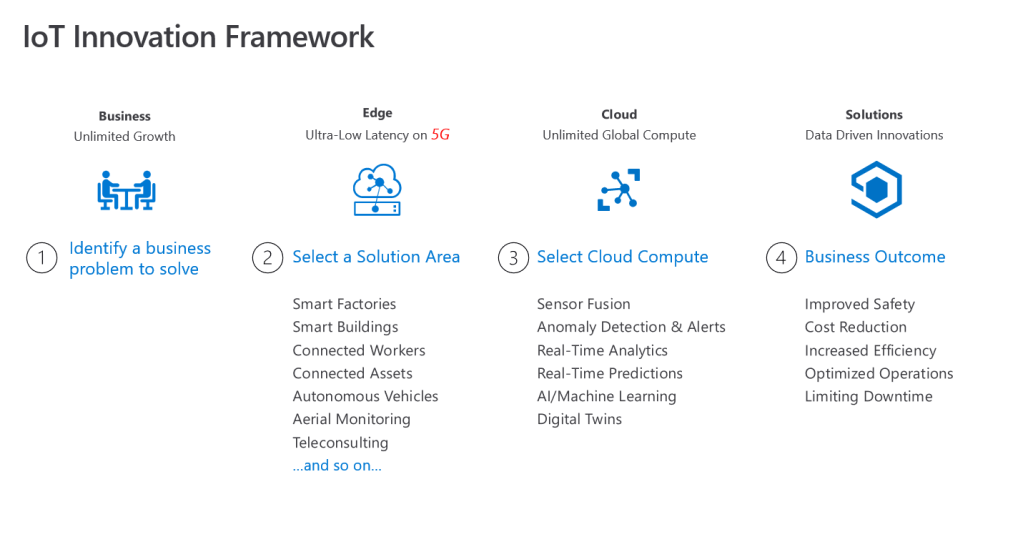
1. Identify a Business Problem to Solve
Innovation starts with solving a problem. There could be many problems to solve, especially in a large organization, but we can always start by picking the most significant one to solve that leads to the highest impact.
For many businesses, the problems to solve can be identified by analyzing your customer needs through research. You can read more about my article on Data Driven Customer Insights with Azure App Modernization and Cloud Native Apps.
Example
To illustrate this step, let us apply the framework with the example of COVID vaccine delivery. Vaccine delivery is complex, it requires vaccine to be kept under strict environments, sometimes at -80°C and -60°C. Additionally, there is a global shortage on vaccines. Optimizing deliveries and reducing wastage would enable more people to be vaccinated quickly.
2. Select a Solution Area
IoT can be used across various industries such as Healthcare, Government, Retail, Manufacturing, Smart Spaces, Agriculture, etc. You can refer to Microsoft’s list of customer success stories by region or industry. In the IoT Innovation Framework, several technology solution areas which are emerging are listed, but it is non-exhaustive. This shortlist enables you to innovate in areas where there are room for break-throughs.
| Solution Area | Description | Success Story |
| Smart Factories | Monitor manufacturing processes to operate better | Link |
| Smart Buildings | Monitoring spaces to better understand and optimize it’s usage | Link |
| Connected Workers | IoT wearables enabling workers to operate better | Link |
| Connected Assets | Tracking objects to better understand and optimize it’s usage | Link |
| Autonomous Vehicles | Intelligent vehicles that can operate without a driver. | Link |
| Aerial Monitoring | Monitor open spaces with cameras, sometimes with drones. | Link |
| Tele-Consulting | Monitor or consult health conditions remotely with health practitioners | Link |
On the edge where the sensors are located, critical data can be transferred using low-latency 5G networks. 5G networks are 10-100x faster than 4G networks, and could open up new solutions, where large amounts of data can be transferred to centralized cloud computing in real-time.
Example
For the case of vaccine delivery, in order to track that the temperatures are within the acceptable range, a temperature sensor can be added to the package holding the vaccines. To track the location of the package, we could add an additional GPS sensor. These sensors typically are used in the “Connected Assets” solution area.
3. Select Cloud Compute
The cloud provides a massive amount of computation on-demand. With unlimited compute resources, real-time processing and analysis can be achieved. You can fuse sensor data from different types of sensors (videos, images, location, temperatures), detect for anomalies, analyze and predict outcomes, and visualize complex environments with digital twins.
Example
During the vaccine delivery, sensors would continuously emit data which would then be sent to the cloud for further processing. Should the temperatures fall out of acceptable range, anomalies can be detected, and operators in the field would be notified immediately to rectify the situation. From the location data collected, the delivery date and and target time can be estimated to better optimize logistics arrangements.
4. Business Outcome
With the adoption of IoT, many a times we see business value delivered through improved safety, reducing and optimizing costs, increased efficiency with optimized operations, and limiting downtime.
Example
With the adoption of IoT in vaccine delivery, we have reduced the risk of damaging the vaccines as they are kept under the right conditions. This leads to improved safety for people who would be injected with the vaccine, and reduction of costs from damaged vaccines. The location tracking data can be used to better predict delivery times in future, to optimize routes, increase supply chain efficiency and reduce costs. With better forecast of demand, downtime can be reduced too.
Another Use Case Illustrated
Let us look at solving another problem with this IoT Innovation Framework.
During COVID, many countries went into lockdowns or semi-lockdowns. Many businesses suffered loses, especially the mum-and-pop shops that lived on their sales day by day.
Firstly, let us define the business problem to solve – “How to continue operating my food store business even in a lock-down?”
For a tech-startup, they may choose to solve the business problem with an IoT Solution Area such as Autonomous Vehicles or Guided Vehicle-to-Everything (V2X). The tech-startup would be able to collect online food orders, send that information to the vehicles to pick-up food orders at designated safe zones. Once the food is loaded, it then moves off to deliver the food to customers at their door-step.
The cloud in this case could be used to process purchase orders, analyze and predict demands, optimize pick-up and delivery times to minimize contact between people.
With the use of IoT in the autonomous vehicles, we can achieve the business outcome of improving safety by reducing risks of infection. We have limited the downtime of businesses, as the vehicles can still operate in a pandemic, sustaining businesses and livelihoods.
Summary
The IoT Innovation Framework can be used across different industries, businesses and use cases, because it is based on the capabilities of the underlying technology – Data and Internet. With the use of High-Speed Networks, Cloud and AI, the possibilities are unlimited.
If you think this framework is useful for you, or you like to discuss this topic further, please send me a message or a “like”, so I will be notified. Thank You!
 Thoughts