
Ready to unlock new customer opportunities and accelerate sales for your software on Azure? Achieving the “Solutions Partner with Certified Software Designation” unlocks new opportunities and more.
Why Certified Software Matters for Your Business?
- Enhanced Market Credibility: Demonstrates that your solution meets Microsoft’s rigorous technical standards, boosting trust with customers and partners.
- Increased Cosell Opportunities: Unlocks access to Microsoft’s cosell programs, enabling joint go-to-market activities and greater visibility within Microsoft’s ecosystem.
- Customer Confidence: Validates the quality, reliability, and security of your solution, making it easier for customers to choose and deploy your software on Azure.
- Faster Sales Cycles: Streamlines procurement and technical due diligence for enterprise customers, helping accelerate deal closures.
- Priority Placement in Microsoft Marketplace: Increases your solution’s discoverability and preference in the Azure Marketplace, driving more leads and business growth.
Start your journey by selecting one of Microsoft’s defined Industry AI use cases, these are the top AI use cases which would maximize your profitability. Then, plan to meet the eligibility criteria for Certified Software designation, as below,
- Works with Microsoft Cloud: Your solution must technically fit and work well with Microsoft’s cloud platforms.
- Industry Scenario Alignment: Your solution must solve a real problem that matches one of Microsoft’s defined industry use cases. Refer https://aka.ms/IndustryCloudCustomerScenarios.
- Pass an AI technical review: Your solution must pass a technical check showing it uses Microsoft AI tools or features in a meaningful, industry-specific way (like building a Copilot, using Generative AI, or integrating with Microsoft Fabric).
- Marketplace Readiness: Your solution must be listed, transactable and available for purchase on Microsoft’s marketplace to qualify for the Industry AI certification.
- Proven Customer Success: You need to show real-world success by sharing at least two customer stories that prove your solution delivers value using AI in a specific industry.
Be Audit-Ready in 6 Steps
Here’s a simple, actionable checklist to get your solution audit-ready.
1. Review General Criteria
- Ensure your solution is built on Azure and follows Microsoft’s recommended architecture practices.
- Prepare a clear architecture diagram showing integration points with customer resources, especially data sources. Refer Reference diagram requirements.
2. Demonstrate Your Solution
- Record a demo (video or live session) of your solution running in Azure, highlighting all major components.
3. Complete the Azure Well-Architected Review
- Self-assess your solution for Reliability, Security, and Operational Excellence.
- Achieve at least a “Moderate” score in each area.
4. Check Your Azure Advisor Score
- Ensure your production environment scores at least “Moderate” for Reliability, Security, and Operational Excellence.
- Address or document any outstanding recommendations.
5. Validate Cloud Security Posture
- Use a Cloud Security Posture Management (CSPM) tool (e.g., Microsoft Defender for Cloud).
- Provide a security score screenshot from the last 30 days.
- Remediate any critical security findings.
6. Prepare Category-Specific Evidence
Identify your solution’s primary workflow, you only need to select and prepare evidence for the SINGLE category that best matches your solution’s main function.
- Data Operations and Management Solution: Solutions that enrich, process, or manage customer data—such as cleansing, warehousing, analytics, or business intelligence—by operating on or integrating with customer-owned data sources within Azure.
- AI/ML Integration: Solutions that apply artificial intelligence or machine learning—like predictive analytics, natural language processing, or custom AI models—to automate, optimize, or enhance customer processes, and that interoperate with customer Azure services.
- Customer Deployed Services: Solutions that are deployed directly into the customer’s Azure environment (e.g., VMs, containers, managed apps, agents) to extend, integrate with, or enhance their existing infrastructure, possibly with hybrid or SaaS orchestration.
- Control Plane, Orchestration, and DevOps: Solutions that provision, manage, or orchestrate customer Azure resources—such as automating deployments, scaling, configuration, or DevOps workflows—using Azure-native or partner-hosted orchestration logic.
2.1 Data Operations & Management
What evidence to prepare
- Data ingestion from customer sources — explanation + artifacts.
- Processing occurs on Azure —Prove all transformation/processing runs on Azure services (your tenant, customer tenant, or both).
- Data residency in Azure — storage configuration on how regional requirements are met (customer and partner regions).
- Secure access/transport/handling — encryption in transit & at rest, identity/access control, and customer‑initiated revocation path
- If using customer data for AI/ML — show PII scrubbing for shared models; or private model storage boundaries and access controls.
Don’ts
- Don’t offload core processing to non‑Azure platforms or on‑prem if it bypasses Azure‑hosted services.
- Don’t store customer data outside Azure or ignore regional residency obligations.
- Don’t access customer data over non‑encrypted channels or without customer‑managed revocation controls.
- Don’t train shared models on raw customer data containing PII.
2.2 Artificial Intelligence / Machine Learning Integration
What evidence to prepare
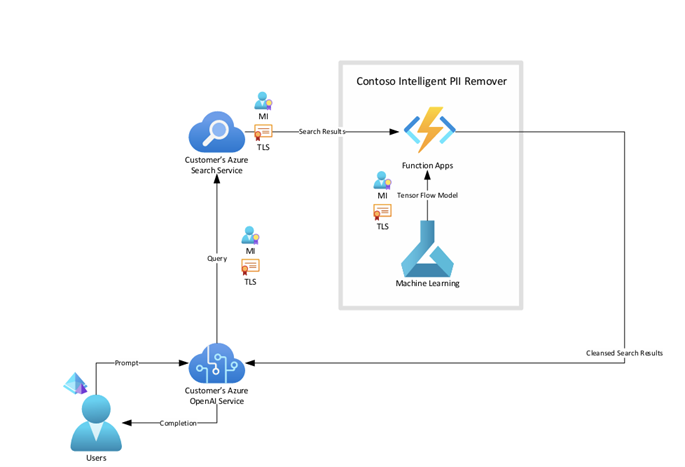
- Interoperation with customer Azure services — diagrams/deployment models/integration patterns (e.g., Azure AI Search, customer data sources, customer‑hosted models).
- Model operations on Azure — architecture/pipeline diagrams and environment configs showing training/inference/augmentation purely on Azure.
- Differentiated AI value — documentation that your solution adds features beyond wrapping native services (domain tuning, workflows, proprietary logic).
Don’ts
- Don’t present a simple proxy to Azure OpenAI/Cognitive Services with no enhancement.
- Don’t execute model ops on non‑Azure platforms.
2.3 Customer Deployed Services
What evidence to prepare
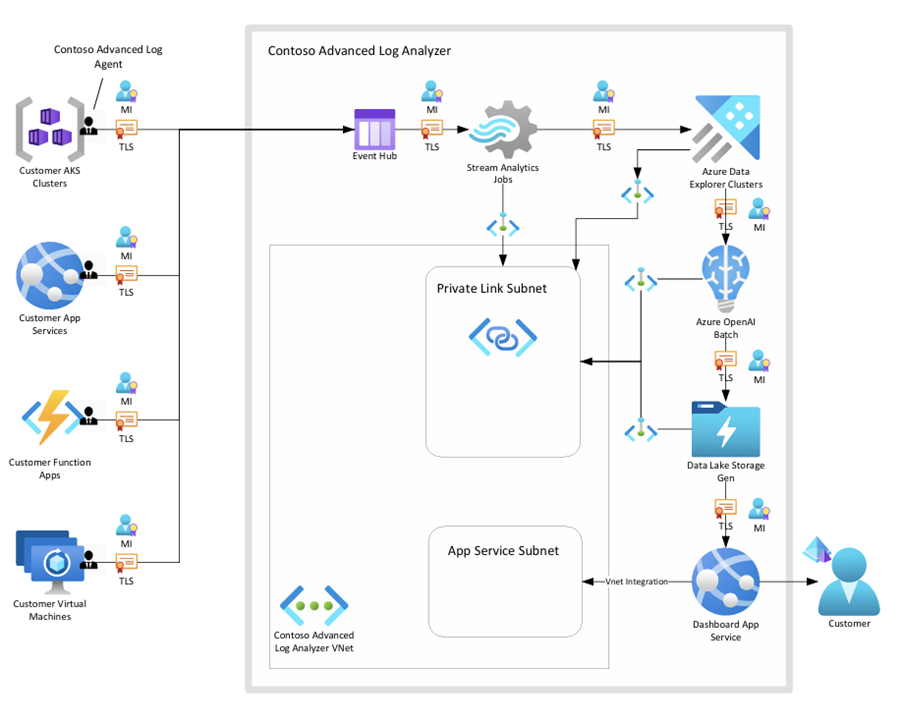
- Customer environment deployment & execution — diagram identifying what installs in the customer tenant (VMs, containers, agents, managed app) and execution boundaries; include on‑prem/device extensions if any.
- Azure‑centric operations — diagrams showing Azure is the foundational platform (even if hybrid with on‑prem/devices) and how those components report to or are coordinated by Azure services.
- Secure & controlled access — access flowcharts and identity/security docs (encryption, identity‑based auth, revocation; separation of duties if SaaS control plane).
- Secure & controlled access — access flowcharts and identity/security docs (encryption, identity‑based auth, revocation; separation of duties if SaaS control plane).
Don’ts
- Don’t operate without meaningful reliance on Azure services.
- Don’t allow persistent, overly broad credentials or non‑auditable access to customer resources.
2.4 Control Plane, Orchestration & DevOps
What evidence to prepare
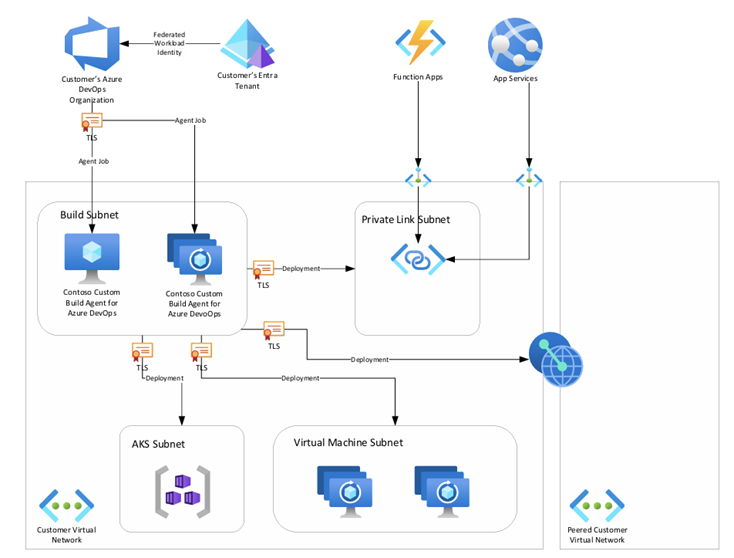
- Azure resource interoperation — diagram/list of all points where you provision/modify/orchestrate customer Azure resources (ARM/Bicep/APIs, scaling, CI/CD).
- Azure‑based operational execution — flow/architecture showing the control logic executes in Azure (Functions, Logic Apps, VMs, AKS, partner‑hosted SaaS) and how cross‑tenant flows remain within Azure.
- Secure access to resources — security architecture + credential management practices (Entra roles, Managed Identities, scoped service principals; prod vs non‑prod separation; revocation).
Governance & policy compliance — documentation of how you respect customer management hierarchy and Azure Policies; default to Audit effect for new policies pending customer review.
- Operational transparency — samples/screens showing logs of actions (who/what/when/outcome), customer access to records, and retention policy (≥90 days recommended).
Don’ts
- Don’t execute orchestration outside Azure or route control traffic through non‑Azure platforms.
- Don’t use broad, persistent credentials or omit revocation paths and environment separation.
- Don’t bypass customer policies/management scopes or enable “Deny/Modify” without review.
- Don’t operate as a black box—lack of customer‑visible logs will fail transparency expectations.
Conclusion:
Planning ahead with the certification requirements in mind is essential before starting any new project. By understanding and aligning with Microsoft’s audit and technical criteria from the outset—such as marketplace readiness, industry scenario alignment, and AI technical standards—you’ll save time, reduce rework, and set your solution up for a smoother path to certification and sales opportunities. Early preparation ensures your team can focus on innovation and customer value, rather than scrambling to meet requirements at the last minute.
Would you like to elevate your software solution today?
Disclaimer:
Audit and certification requirements are subject to change. Always check the latest official Microsoft documentation and requirements during your audit preparation to ensure compliance.
Industry AI Use Cases Sample Reference
| Industry | Use Cases |
|---|---|
| Financial Services | 1. Customer Engagement 2. Augmented Intelligence 3. Contact Center Modernization 4. Customer Insights 5. Banker Productivity 6. Cross-group Collaboration 7. Employee Wellbeing 8. Real-time Communications 9. Risk Analytics & AI 10. Financial Crime Protection 11. Regulatory Compliance & Reporting 12. Core Banking Modernization 13. Data and Cashflow Forecasting 14. Card Issuing and Merchant Acquiring 15. Payments Transformation |
| Healthcare | 1. Personalized Care 2. Patient Insights 3. Virtual Health 4. Care Coordination 5. Remote Patient Monitoring |
| Manufacturing | 1. Connected & Enabled Workers 2. Production Monitoring & Optimization 3. Material Handling & Quality 4. Visibility & Risk Management 5. Digital Twins & Simulations |
| Retail | 1. Unified Customer Profile 2. Shopper & Operational Analytics 3. Intelligent Store 4. Real-Time Personalization 5. Seamless Customer Service |
| Sustainability | 1. ESG Data Intelligence 2. Calculate ESG Footprint 3. Analyze ESG Performance 4. Minimize Environmental Impact of Facilities 5. Understand & Manage Sustainability Risk |
 Thoughts