
AI-assisted software engineering is changing the amount of software that a relatively small engineering team can design, implement, test, and operate. Coding agents can increasingly research an unfamiliar repository, analyze dependencies, create implementation plans, generate code, construct tests, review changes, update documentation, and assist with operational analysis.
This creates an important architectural consequence for large transformation programs. If software implementation becomes significantly faster, the primary constraints increasingly move away from code production and toward problem selection, architecture, domain knowledge, integration, security, operational readiness, and coordination between teams.
Traditional Agile programs often respond to additional scope by adding delivery squads. A sufficiently large transformation can therefore accumulate separate application, integration, data, cloud, security, quality, and operations teams, together with the product, architecture, project-management, and coordination structures necessary to keep those teams synchronized.
Hypervelocity Engineering, or HVE, should not reproduce this organizational model while simply adding AI agents to each team.
Instead, HVE should first attempt to increase the span of responsibility that can be owned by a small, senior, multidisciplinary product engineering team. Functional responsibilities become dedicated squads only when the product, number of consumers, technical specialization, or independent lifecycle creates enough sustained demand to justify the additional organizational boundary.
The resulting architecture combines three principles:
- Organize around measurable business outcomes rather than technology output.
- Give humans and engineering agents bounded context and explicit contracts so that they can work with greater autonomy.
- Scale engineering through leverage and reuse before scaling through headcount and organizational structure.
Objectives
A multi-squad HVE implementation should optimize more than engineering throughput.
The operating model should preserve business alignment, so that every major capability remains traceable to an explicitly owned outcome rather than becoming an isolated technical deliverable.
It should provide architectural coherence through stable domain boundaries, API and event contracts, authoritative data ownership, identity patterns, non-functional requirements, and reusable engineering standards.
It should support federated autonomy, allowing teams and agents to make local decisions without repeatedly coordinating with the entire transformation organization.
It should embed Security, Trust, and Compliance throughout discovery, engineering, deployment, and operations instead of introducing these requirements as downstream approval activities.
The model should also provide operational and economic observability. Reliability, security events, model behavior, cloud consumption, AI consumption, and business value should be measurable in production.
Finally, the architecture should support continuous learning. Production evidence should be able to change the product hypothesis, requirements, architecture, and future investment decisions.
Establish clear accountability for value and architecture
HVE requires a clear separation between business and technical accountability.
The Business or Product Owner is accountable for the business outcome. This role defines the measurable improvement the organization expects, establishes priorities, and determines whether the resulting capability justifies continued investment.
The Product Manager converts that outcome into product strategy, requirements, and roadmap priorities.
The Lead Solution Architect is accountable for the architecture and boundaries of the overall solution. This role establishes domain ownership, cross-squad contracts, authoritative data responsibilities, identity patterns, shared non-functional requirements, and the boundaries within which individual teams can operate autonomously.
A useful governance model is:
| Concern | Accountable role |
|---|---|
| Business outcome and value | Business/Product Owner |
| Product strategy and roadmap | Product Manager |
| Overall architecture and system boundaries | Lead Solution Architect |
| Domain-specific architecture | Squad/domain architect |
| Delivery | Engineers within the owning functional domain |
| Cross-program dependencies and coordination | Program/Project Manager |
| Security architecture | Security Architecture / Security Engineering |
| Production reliability | SRE / Cloud Engineering & Operations |
| Runtime security | SecOps |
| Cloud and AI economics | FinOps / AI FinOps |
The Lead Solution Architect should therefore control the boundaries, but should not approve every implementation choice. If a decision remains inside an established bounded context and satisfies the relevant contracts, the owning team should normally make that decision independently.
Begin with HVE Discover
Implementation velocity is valuable only when it is applied to a worthwhile problem.
HVE therefore begins with Discover, where the organization establishes whether it understands the problem, the user, the expected value, and the important constraints before agentic engineering begins to accelerate implementation.
The Business/Product Owner remains accountable for the business outcome, while a small discovery group can include:
- Product Management;
- Domain Subject Matter Expert;
- Design/UX;
- Forward Deployed Engineer;
- architecture participation; and
- Data, AI, Security, FinOps, or other specialists when the opportunity requires them.
Design Thinking provides a useful process:
Empathize → Define → Ideate → Prototype → Validate
The purpose is not to create a large requirements document. It is to establish enough evidence to make an informed investment and architectural decision.
A successful Discover cycle should produce a compact set of authoritative information:
Validated opportunity, Problem statement, User and domain evidence, Business-value hypothesis, Economic hypothesis, Success measures, Solution hypothesis
This is the foundation for Product and Domain Architecture.
Business Outcome as Contract
In an AI-native engineering environment, repeatedly providing every agent with a large and frequently changing master specification can become a new coordination bottleneck.
Instead, maintain a small Outcome Contract that changes relatively infrequently.
For example,
capability: assisted-case-resolution
owner: operations-product
user:
role: case-worker
job: resolve-customer-case
business_outcome:
metric: average-resolution-time
baseline: 24m
target: 16m
experience:
- remain-in-existing-workflow
- show-supporting-evidence
- require-confirmation-for-consequential-actions
constraints:
- preserve-user-authorization
- prevent-cross-customer-data-access
- maintain-auditability
economics:
metric: cost-per-successful-case
All affected teams and agents can consume this compact context without having to ingest every detailed implementation specification.
Product and Domain Architecture
The Lead Solution Architect translates the validated opportunity and outcome contract into the boundaries required for distributed engineering.
These boundaries can include:
- bounded contexts;
- capability ownership;
- API contracts;
- MCP tool contracts;
- event schemas;
- authoritative data ownership;
- identity and authorization;
- common non-functional requirements;
- trust boundaries;
- extension points;
- integration patterns; and
- approved technology and deployment patterns.
The architectural objective is to minimize the amount of context that must be synchronized globally.
A useful principle is:
Share outcomes and contracts globally. Keep implementation context local.
This becomes particularly important when coding agents are involved because unnecessary context increases processing cost, creates ambiguity, and makes it more difficult for an agent to distinguish authoritative requirements from unrelated implementation detail.
Start with an HVE Product Pod
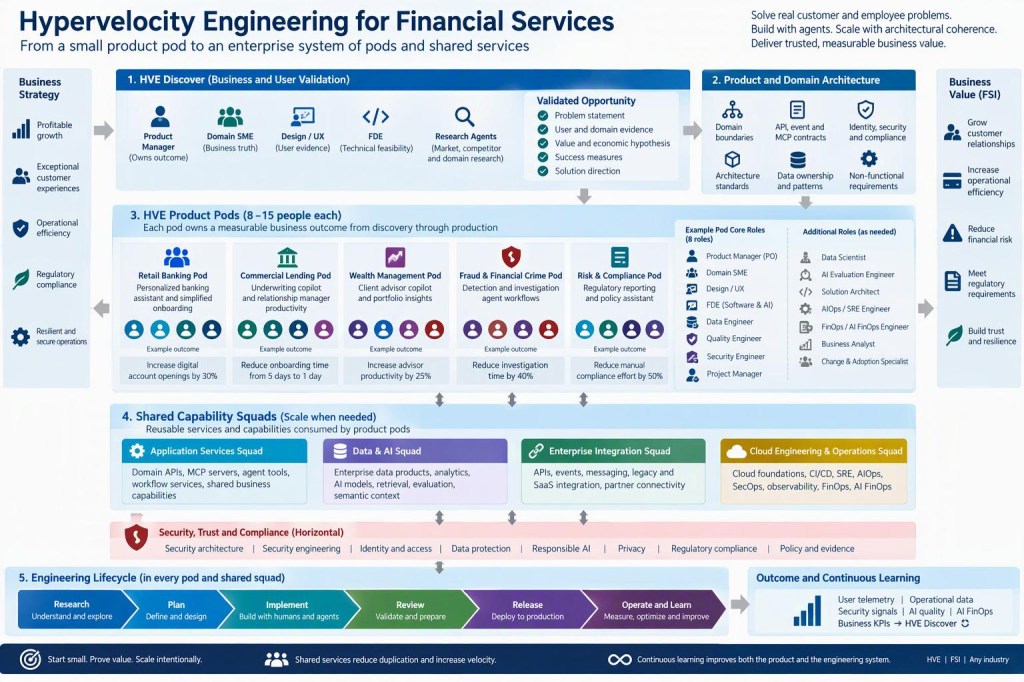
The functional model described in this architecture should not initially be interpreted as five separately staffed delivery organizations.
For many products, a small multidisciplinary HVE Product Pod of approximately 8–15 experienced engineers and specialists can span several functional domains, with AI agents multiplying execution capacity across Research, Plan, Implement, and Review.
A conceptual structure is:
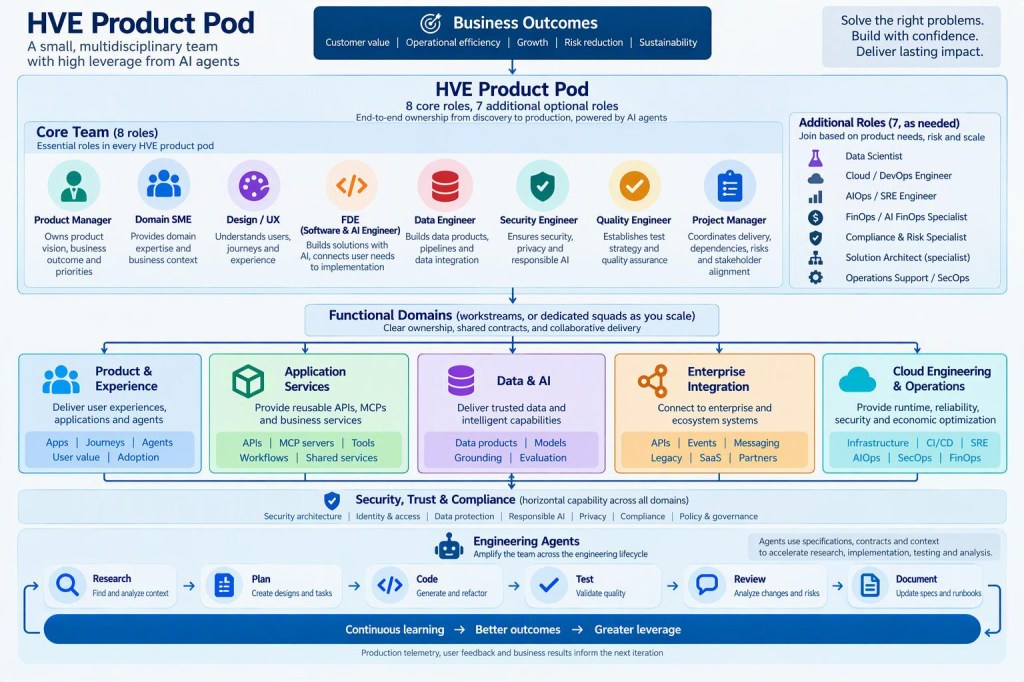
The functional domains represent ownership boundaries before they represent staffing boundaries.
An engineer can initially contribute to more than one domain. Shared specialists can participate fractionally. Agentic engineering and reusable platform capabilities reduce the need to duplicate supporting roles across several small teams.
Functional Domain 1: Product and Experience
Product and Experience owns the connection between business value, users, and production functionality.
This domain can include customer and employee experiences, web and mobile applications, business processes, agentic experiences, application features, and domain-specific services that remain local to the product.
Typical responsibilities include:
- product requirements;
- user journeys;
- experience design;
- business rules;
- domain behavior;
- application development;
- agentic experiences;
- accessibility;
- acceptance criteria; and
- outcome measurement.
Typical roles include Product Management, Domain SMEs, Design/UX, FDE or Solution Architecture, Software Engineering, Quality Engineering, and AI or Data Engineering when required.
Product owns the requirement throughout the lifecycle. It does not hand the requirement to engineering and relinquish responsibility.
Functional domain 2: Application Services
Application Services becomes important when capabilities need to be reused across multiple product experiences, applications, or agents.
It provides a productization layer between experiences and underlying enterprise systems.
Capabilities can include:
- domain APIs;
- MCP servers;
- agent tools;
- workflow services;
- rules services;
- document services;
- notification services;
- orchestration;
- common SDKs; and
- other reusable application services.
A useful graduation rule is:
When a capability is consumed by multiple products or agents and requires an independent lifecycle, it should be considered for promotion from a local product capability into Application Services.
For example, several agents should not independently implement customer lookup, approval, document retrieval, or case creation when these can be exposed through common governed tools.
MCP becomes particularly useful because it creates an explicit boundary between agent reasoning and enterprise action execution.
Typical roles include an Application or Solution Architect, API Engineers, MCP/Tool Engineers, Software Engineers, Quality Engineering, Developer Experience, and Security Engineering support.
Functional Domain 3: Data and AI
Data and AI owns reusable information and intelligence capabilities.
Its responsibilities can include:
- governed data products;
- data pipelines;
- Microsoft Fabric and OneLake capabilities;
- analytical models;
- Microsoft Foundry-based AI capabilities;
- grounding and retrieval;
- semantic context;
- models;
- reusable AI services;
- evaluation; and
- AI telemetry.
Agentic applications require stronger evaluation than demonstrations alone. Relevant evaluation measures can include groundedness, task completion, retrieval quality, tool-call accuracy, safety, escalation behavior, authorization behavior, latency, and cost.
Typical roles include Data Architects, Data Engineers, AI Engineers, Data Scientists, AI Evaluation Engineers, and Data Governance specialists.
Functional Domain 4: Enterprise Integration
Enterprise Integration owns connectivity to systems outside the bounded application architecture.
Depending on the organization, these can include legacy applications, SaaS systems, ERP, CRM, partner ecosystems, industry platforms, and external services.
Capabilities can include:
- Azure API Management;
- Azure Service Bus;
- Azure Event Grid;
- Azure Functions;
- Azure Logic Apps;
- event contracts;
- messaging;
- legacy adapters;
- SaaS connectivity;
- partner interfaces; and
- system-to-system identity.
Typical roles include Integration Architects, API and Messaging Engineers, Backend Engineers, Quality Engineers, Data Engineering support, and Security Engineering support.
The distinction from Application Services is important.
Application Services exposes reusable business capabilities. Enterprise Integration connects those capabilities to systems outside the domain boundary.
Functional Domain 5: Cloud Engineering and Operations
Cloud Engineering and Operations provides the engineering and runtime foundation required by all other functional domains.
Its responsibilities can include:
- Azure foundations;
- infrastructure as code;
- CI/CD;
- development environments;
- workload identity;
- secrets integration;
- deployment automation;
- observability;
- service-level objectives;
- site reliability engineering;
- AIOps;
- SecOps;
- cloud FinOps; and
- AI FinOps.
Typical roles include Cloud or Platform Architects, Cloud Engineers, DevOps Engineers, SREs, AIOps Engineers, SecOps Engineers, Cloud Security Engineers, and FinOps/AI FinOps specialists.
The goal is to provide a paved engineering road so that Product, Application Services, Data and AI, and Integration teams do not repeatedly solve deployment, observability, reliability, or cost-management problems.
Security, Trust, and Compliance remain horizontal
Security should not be delegated solely to Cloud Engineering and Operations.
Every functional domain owns the security of what it produces, while a horizontal Security, Trust, and Compliance capability provides specialist architecture, standards, reusable controls, and assurance.
This can include:
- security architecture; threat modeling; identity and authorization; data protection; privacy; DevSecOps; GitHub Advanced Security and CodeQL; Azure Policy; Microsoft Defender for Cloud; Responsible AI; compliance; and audit evidence.
Specialist participation should be proportional to risk rather than duplicated identically across all teams.
Separate Security Engineering from SecOps
Security Engineering and SecOps solve related but different problems.
Security Engineering asks:
Are we designing and building the system securely?
SecOps asks:
What is happening in production, is it malicious, and how should we respond?
Operational SecOps therefore belongs closely with Cloud Engineering and Operations, while Security Engineering remains horizontal.
A Microsoft-oriented SecOps architecture can incorporate Microsoft Sentinel, Microsoft Defender XDR, Defender for Cloud, and Microsoft Security Copilot as appropriate.
Security incidents should generate engineering evidence. Findings can update threat models, platform policies, architecture decisions, or squad backlogs.
Use bounded specifications for agentic engineering
A single master specification becomes difficult to maintain as the number of squads and agents increases.
Instead, organize context according to ownership.
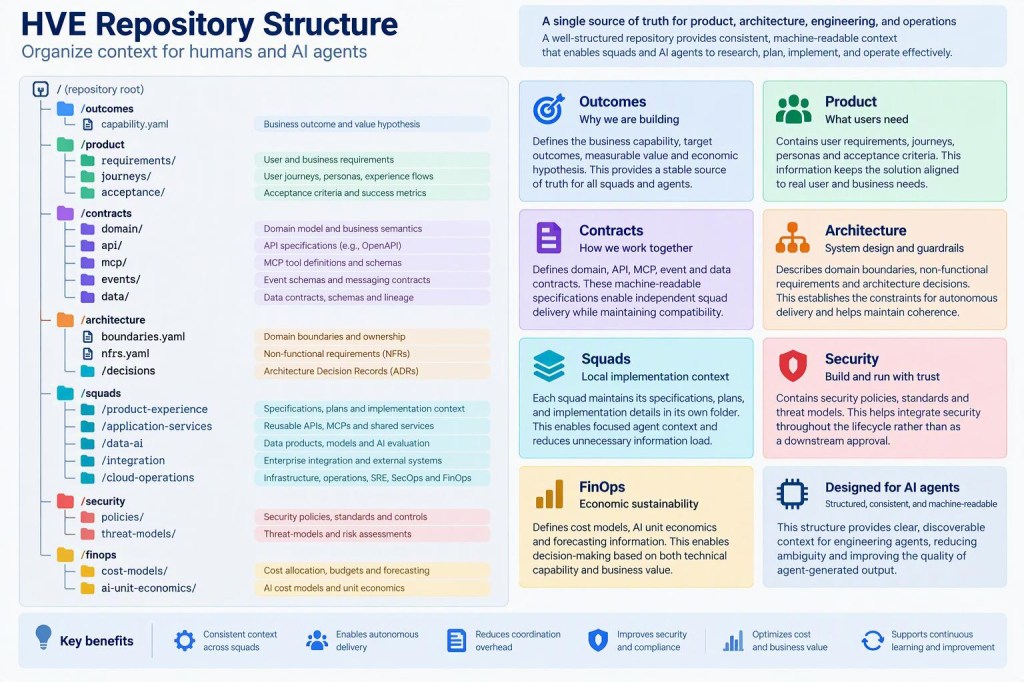
Each squad’s agents can receive a context manifest that references only its relevant outcome, architecture, contracts, policies, and local engineering information.
The design principle becomes:
Humans have bounded contexts. Services have bounded contexts. Engineering agents should have bounded contexts as well.
Treat cross-squad interfaces as contracts
Squads should synchronize through machine-readable contracts wherever practical rather than through repeated meetings or natural-language documents.
These contracts can include:
- OpenAPI definitions;
- MCP tool schemas;
- event schemas;
- data contracts;
- identity requirements;
- service-level objectives; and
- testable non-functional requirements.
For example, Product and Experience might require a customer-order capability. Application Services can expose a governed get_customer_orders tool. Enterprise Integration can connect that capability to the underlying order system. Data and AI can provide exception reasoning. Cloud Engineering and Operations can provide telemetry and reliability.
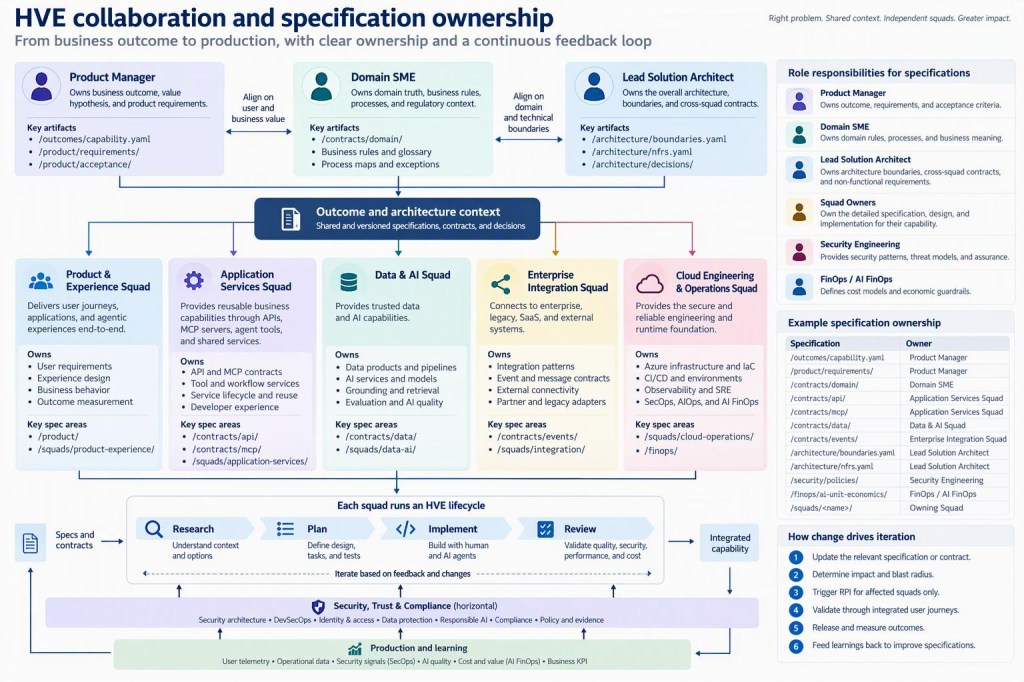
Each functional domain can independently change its implementation while the shared contract remains valid.
This is a critical enabler of Hypervelocity.
Use change-driven RPI
Each functional domain follows:
Research → Plan → Implement → Review
However, a change in one specification should not cause every team and agent to restart its engineering cycle.
Instead, determine the blast radius of the change.
A UI change can remain within Product and Experience. An MCP schema change affects Application Services and its consumers. A change to authoritative customer data affects Data and AI and dependent contracts. A change that allows an agent to perform a consequential action involves Security Engineering and potentially architecture governance.
Only the affected teams and agents need to reload context and repeat Research, Plan, Implement, and Review.
Connect user requirements to integrated acceptance
Component-level success does not establish product success.
An API can work, the MCP tool can work, the model can pass its evaluation, and the application can render correctly while the end-to-end user journey still fails.
Integrated validation should therefore return to the original requirement:
Design/UX and Domain SMEs remain involved in this validation even when they are not permanently embedded in every technical domain.
Incorporate AI FinOps into engineering decisions
Agentic systems introduce variable consumption through model selection, tokens, retrieval, tool execution, evaluation, Fabric workloads, and supporting Azure infrastructure.
AI FinOps should therefore progress beyond reporting token consumption.
This allows architects to reason about quality and economics together.
A more expensive model can have better economics if it completes substantially more tasks successfully. Conversely, applying a high-cost reasoning model to a deterministic classification problem can be architecturally inefficient.
The economic hypothesis established during Discover should therefore become measurable production evidence.
Scale from functional domains to squads only when necessary
The five functional domains should not automatically become five dedicated squads.
A small HVE Product Pod can initially span them.
Consider creating a dedicated squad when one or more of these conditions emerge:
Multiple consumers
The capability is serving several independent product teams or use cases.
Independent lifecycle
The capability requires independent release, servicing, or roadmap management.
Sustained engineering demand
The domain has sufficient continuous work to justify dedicated engineering ownership.
AI leverage does not directly equate with headcount
A small HVE pod can potentially produce an amount of accepted software that historically required a materially larger Agile delivery organization, particularly for greenfield cloud applications with reusable services, automated testing, machine-readable architecture, and strong engineering standards.
However, a statement such as “10 HVE engineers equal 100 Agile engineers” should not be made without measured evidence.
AI cannot eliminate bottlenecks such as regulatory approvals, organizational decisions, data migration, inaccessible legacy systems, hardware deployment, external vendors, or manual operational processes.
The appropriate measure is effective delivery capacity, not theoretical headcount equivalence.
Organizations can measure:
- requirement-to-production lead time;
- deployment frequency;
- accepted capabilities per quarter;
- engineering hours per accepted capability;
- percentage of work delegated to agents;
- agent output accepted without material rework;
- integration wait time;
- escaped defects;
- security exceptions;
- cost per delivered capability;
- Azure and AI cost per successful outcome; and
- business-value realization.
This allows the organization to quantify the actual leverage produced by HVE.
Production closes the engineering loop
Production should provide evidence across several dimensions:
This turns HVE from a development methodology into a continuous product-learning system.
Recommendations
When applying this operating model, consider the following recommendations.
Start with one multidisciplinary product pod. Use functional domains to clarify ownership before creating organizational boundaries.
Make Product responsible for the requirement throughout the lifecycle. Do not move accountability to technical squads because implementation crosses several systems.
Treat the Lead Solution Architect as the owner of boundaries rather than every implementation decision. Architecture should make autonomy possible.
Use small Outcome Contracts and explicit cross-domain contracts. Avoid large master specifications that every agent and team must continuously reread.
Create bounded context for engineering agents. Give agents the authoritative outcome, relevant contracts, architecture, security requirements, and local squad context required for their task.
Promote reusable capabilities deliberately. APIs, MCP servers, workflows, tools, and shared services should graduate into Application Services when several products need them.
Keep Security Engineering horizontal and SecOps operational. Security is an engineering property before it becomes an operational detection problem.
Include AI FinOps during architecture and discover. Measure cost per successful outcome rather than token expenditure alone.
Use production evidence to change requirements. User behavior, security incidents, AI evaluation, SRE data, and economics should all be able to trigger a new HVE cycle.
Scale organizationally only when leverage has been exhausted. Hypervelocity should first increase the amount of responsibility a small high-quality team can own before increasing the number of teams.
Summary
Multi-squad Hypervelocity Engineering is best understood as an AI-native engineering operating model, rather than a larger Agile organization augmented with coding agents.
The model begins with business strategy and an explicitly owned business outcome. HVE Discover combines Product, Domain SMEs, Design/UX, FDEs, and appropriate specialists to establish the right problem, business-value hypothesis, economic hypothesis, and initial solution direction.
A Lead Solution Architect establishes the domain boundaries and contracts that allow engineering to proceed independently. A multidisciplinary HVE Product Pod can initially span Product and Experience, Application Services, Data and AI, Enterprise Integration, and Cloud Engineering and Operations. These functional domains become dedicated squads only when reuse, scale, specialization, or independent lifecycle warrants the additional organizational boundary.
Engineering agents amplify the humans responsible for each domain by accelerating Research, Plan, Implement, and Review. Small global context, bounded local specifications, machine-readable contracts, and change-driven RPI prevent the coordination overhead of a continuously changing master specification.
Security, Trust, and Compliance remain horizontal. SRE, AIOps, SecOps, FinOps, and AI FinOps close the operational loop. Production telemetry connects technical behavior to user experience, security, cost, AI quality, and business outcomes before returning those findings to HVE Discover.
The resulting design principle is:
Hypervelocity does not come from maximizing the number of autonomous agents or engineering squads.
It comes from increasing the span of outcomes that a small, multidisciplinary team can safely own by combining human judgment, bounded agentic execution, reusable capabilities, explicit contracts, continuous trust, and production learning.
Scale the engineering system through leverage first, and scale the organization only when the product demands it.

